Showing posts with label Religious Education. Show all posts

Friday, 18 November 2016

When does 'Christmas time' begin?

I don’t know about you, but I feel like ‘Christmas’ is getting earlier and earlier each year. When I was younger, it seemed like the festivities didn’t start until December 1st - as soon as that first little chocolate (gift or reindeer shaped) was gobbled up from my Barbie advent calendar. Now, we start hearing whispers about it in October. In-between Halloween and Bonfire Night, those whispers get louder, then as soon as the fireworks are over, it’s CHRISTMAS, CHRISTMAS, CHRISTMAS!

Now, with that in mind, I thought it was a good time to think about the ways in which schools can help children learn about the ‘Christmas story’. There is, of course, the traditional nativity story, which a lot of schools act out for parents. A less well-known variant of the story is ‘Baboushka’, which has origins in Russia.

A while ago, we asked a local teacher to create an activity for us about it. We wanted it to be suitable for children age 6-11. When we had the structure of the task complete, we then asked a brilliant designer to bring it to life. Now, that has been transformed into a FREE activity for iPads. Download it instantly and keep it forever!

If you’re familiar with the popular tool Thinking Kit (or Digital Mysteries), you’ll know the general format. An activity consists of:

  • one main question or objective
  • snippets of information that tell a story or form the bulk of a task (these may have images on them)
  • various tools to help students answer the question/achieve the objective (e.g. the ability to make digital notes, stick related slips together or form a named group)

The activity is then downloaded within the FREE Thinking Kit App - which presents the information to students in the form of an engaging, easy-to-use iPad activity. It's actually designed to be worked on in pairs or small groups, which means it is excellent at helping children develop key skills of collaboration, communication, speaking and listening. It can also be used independently if preferred (or for example, at home).

The Baboushka task comes in three difficulty levels: Basic has 8 slips, Medium has 16 and Advanced has 24. The question students must answer is ‘Why didn't Baboushka follow the kings to Bethlehem?’ It’s a great task for achieving lots of learning objectives in English and Religious Education, and could be used alongside study of the nativity story or Baboushka.

Here’s some of the slips:


To get this FREE activity, please go to www.reflectivethinking.com/baboushka2016. When you use it in class, please do include our Twitter handle @refthinking, we love to see students’ faces when they get hooked into the story!

Tuesday, 15 March 2016

Spring is here!

Spring is upon us. Pastel colours adorn the dummies in clothes shops, the (very) odd day of sunshine promising us that we will be warm one day, and hundreds of different chocolate eggs (more than ever this year) in every shop you enter. This means one thing…Easter is nearly here!


For most people I know, this is always a pleasant time. Children definitely enjoy Easter…among my strongest childhood school memories are harvest festivals and Easter fairs. Whether students need to begin learning about the harder/more serious and complex side of Easter, it's a good time to do it now.. Another element that can make it more engaging and easier to build discussion, is them learning together, in true collaboration.

We have three ways:

  1. Get students to create their own activity about Easter or Spring.

    There are so many things we can talk about and learn at this time of year, whether that's the religious story behind Easter or the blossoming of so many kinds of life in Spring. It's also something that students tend to enjoy. So how about if they were to create an activity for their classmates to use/solve/do? This works well in two ways. It has a Project Based Learning strand. Students must plan, research and structure their own project – a task - but it also has the brilliant edge of helping all students see the topic from different perspectives. This multi faceted technique means they should learn, but also remember, more.

    We suggest Thinking Kit – activities tend to consist of one main open question or objective, then lots of ‘snippets’ – bits of information made up of facts, quotes, research and/or images. The creation side can be done on any device. Once the activity is created, you are given a short code. You enter that in the FREE app and the task downloads instantly.

    The Thinking Kit Creator has a 1 month FREE trial (no card details required) and the Thinking Kit App is free.

  2. Create an engaging activity yourself.

    You could create an activity with Thinking Kit too, then just tell the class your code, and they can instantly start using it on their iPads.

  3. Pre-prepared activity.
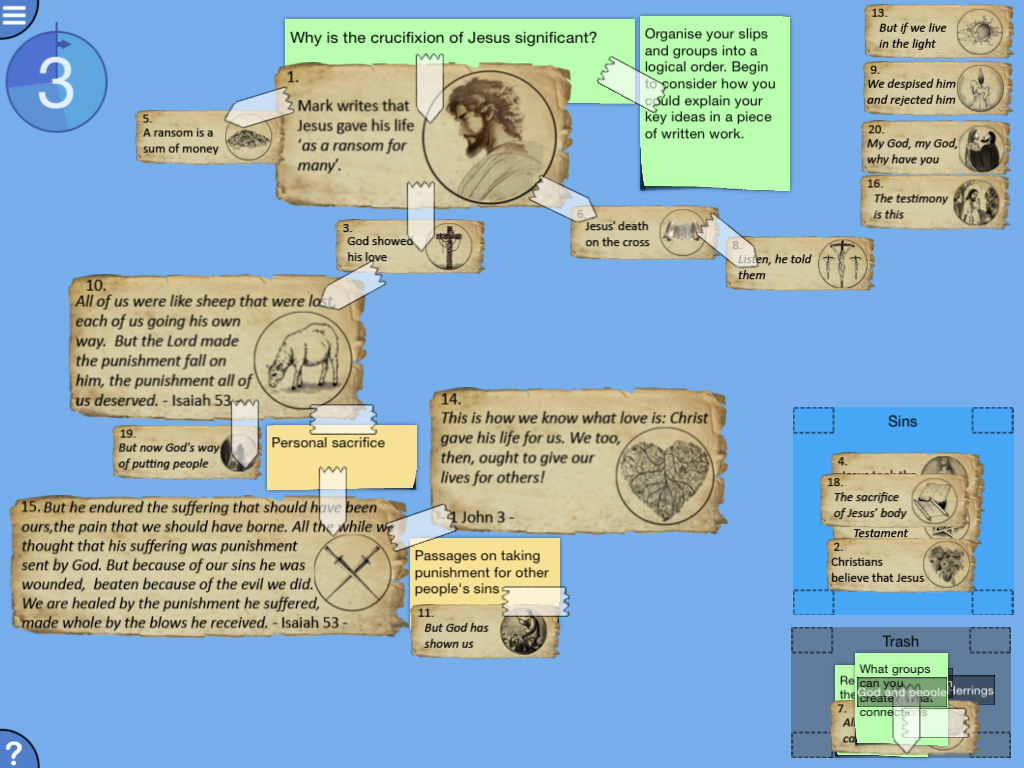
    A screenshot from Digital Mysteries: Crucifixion of Jesus

    Our dedicated app, Digital Mysteries: Crucifixion of Jesus is now down to price tier 1 (79p, 99c, AU $1.49) from price tier 2 (£1.49/US $1.99/AU $2.99). Students ideally work in pairs but can work alone or in small groups too. They're given little illustrated slips on screen, ranging from passages from the bible and Christian beliefs of the crucifixion of Jesus. They have to read and work through these together in order to answer, ‘Why is the crucifixion of Jesus significant?

    The app is designed for collaboration so there are plenty of discussion triggers and ways of expressing opinion, e.g. the group, sticky tape and note tools. It can be used with 11-16 year olds as it has three difficulty levels – as the difficulty level goes up, more slips are given, which may introduce complexity and a new strand to consider.

    For more information, please search ‘Digital Mysteries Jesus’ on the App Store or click here.

Thursday, 2 April 2015

Learning about the Crucifixion of Jesus on iPads

With Easter weekend upon us, we’ve released an iPad app to help students age 11-16 learn about the topic in an interactive way. Rather than the usual price of £1.49, the app is FREE for the whole of April. Click here to download now.

Don’t have iPads? Try our free Windows PC/laptop/whiteboard trial here.

Digital Mysteries: Crucifixion of Jesus is a unique app which allows pairs to work simultaneously on one iPad – designed to encourage discussion and collaboration on the question ‘Why is the crucifixion of Jesus significant?’

Users are given digital, illustrated slips of information which look across different Biblical writings concerning the crucifixion. Direct quotes are included within these. They must read them all, organise them into groups and then arrange into a sequence to represent their thought pattern in coming to an answer. To give a full answer, students will have to build their argument using quotes from the Old Testament and New Testament as well as their own ideas.

Following the process of solving the task, an automatic report with screenshots and information of the session can be shared or printed. Students can also go through the Reflection Stage in which they playback the process and reflect on their ideas. This can be done alone, with their group, with their teacher or even as a class. It is an excellent way to help develop higher level thinking skills, while at the same time, learning information crucial to their education and exams.

The mystery comes with 3 difficulty settings. On the easy setting, there are 14 slips, medium, 18 and hard, 20. As the difficulty level increases, the added slips provide more information to help students focus on different elements.

Who is this app for?

This app works well with those aged 11-16. By having three difficulty levels, it supports differentiation in class and can be suited to varying abilities/levels of knowledge. As the difficulty level goes up, more slips are added which bring in more complex discussion points and themes. There is also different hints provided depending on which level you are on to help with grouping or sequencing. Sub questions are suggested too which help teachers streamline the session to what they would like students to focus on.

What is different about Digital Mysteries?
  • Truly collaborative: It is unique in that more than one student can interact with it at once 
  • Retention: Working with information slips from two different perspectives (grouping, then fitting them into a sequence) ensures students remember more
  • Higher-level thinking: The multiple discussion points, combined with the task’s open-ended nature, leads to students developing these skills
  • Engagement: Mysteries split bulks of information into short snippets which makes it more digestible, plus working with peers leads to higher engagement levels
What does a mystery consist of?
  • Illustrated slips: Including facts on the topic alongside story-based snippets about a particular character and their experiences
  • Open question: To maximise the potential of discussion and expression of ideas, the nature of the task is usually open ended
  • Extras: Most tasks come with personalised hints for those who need them. E.g. suggestions for grouping or sequencing their slips
  • Description: This gives teachers the information they need to plan their session including the curriculum point each task links to, the advised age range and possible learning outcomes